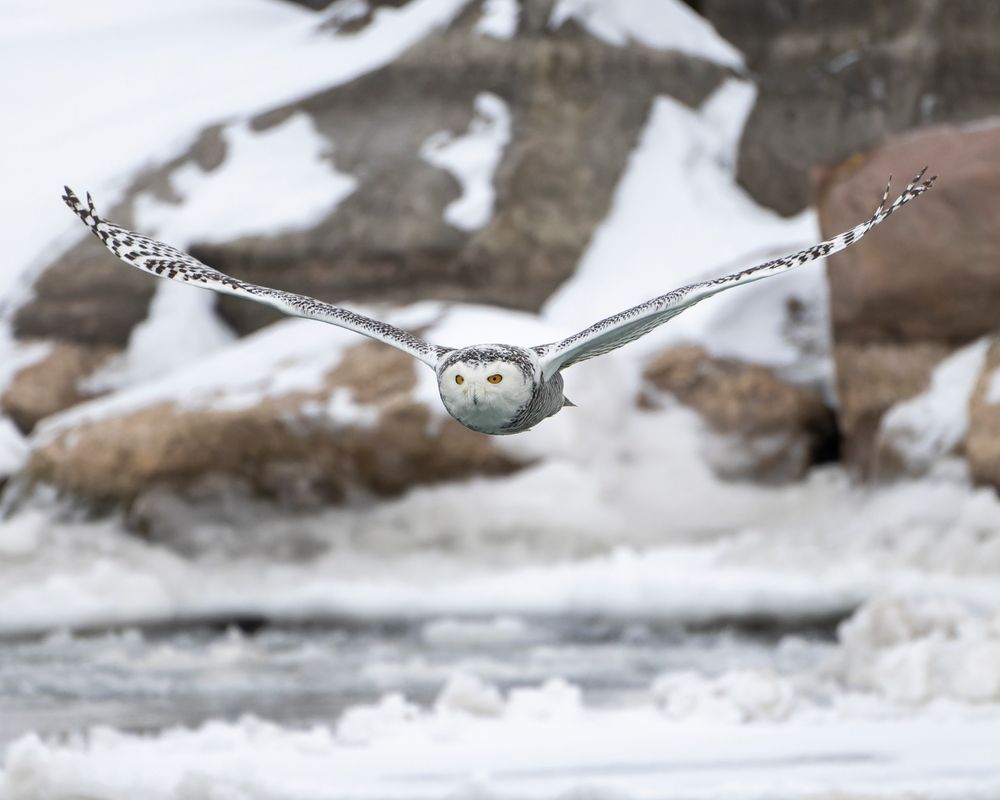
A scientific portrait of a Snowy Owl (Bubo scandiacus) in full flight, highlighting wing morphology, feather structure, and the silent-flight adaptations that allow this Arctic predator to hunt efficiently over open terrain.
This photograph captures a Snowy Owl (Bubo scandiacus) in active, level flight—an opportunity that allows close examination of the species’ unique aerodynamics. The broad, rounded wings display the characteristic primary feather spacing that enables near-silent movement, a trait shared with many owl species but unusually important for a diurnal hunter that relies on stealth in open tundra and coastal environments. The visible dark barring on the wings and chest indicates a female or juvenile, as adult males become progressively whiter with age. The owl’s forward-directed gaze, large facial disc, and intense yellow eyes reflect its binocular vision and heightened auditory precision, both crucial for locating prey beneath snow or across open fields.
The photograph also illustrates the Snowy Owl’s strong, energy-efficient flight style, adapted for long-distance winter movements and irruptive migrations linked to lemming population cycles. By positioning the bird against a neutral, winter-toned background, this image draws attention to its anatomical adaptations—dense insulating plumage, long primary feathers, and powerful pectoral musculature— that allow it to function as one of the Arctic’s most capable apex predators. This scientifically grounded composition highlights the species’ ecological role and the biomechanics behind its silent precision in flight.